New SolidWorks weekend intake starts 18 Aug — limited seats available.

03-8063 0414

Mandatory Compliance Governance

Advanced Prevention, Detection, and Response Strategies for ABAC, AML & Human Rights

Strengthen corporate compliance with our Advanced ABAC, AML & Human Rights Course at CAD Training Centre, Malaysia. This 2-day, HRD Corp claimable programme covers MACC Act Section 17A, T.R.U.S.T. framework, bribery prevention, detection, whistleblowing, investigations and corrective actions. Manage compliance risks and improve governance. Physical, online, and in-house classes available."

  • Duration 2 Days
  • Level Intermediate
  • Format Face-to-face

About this course

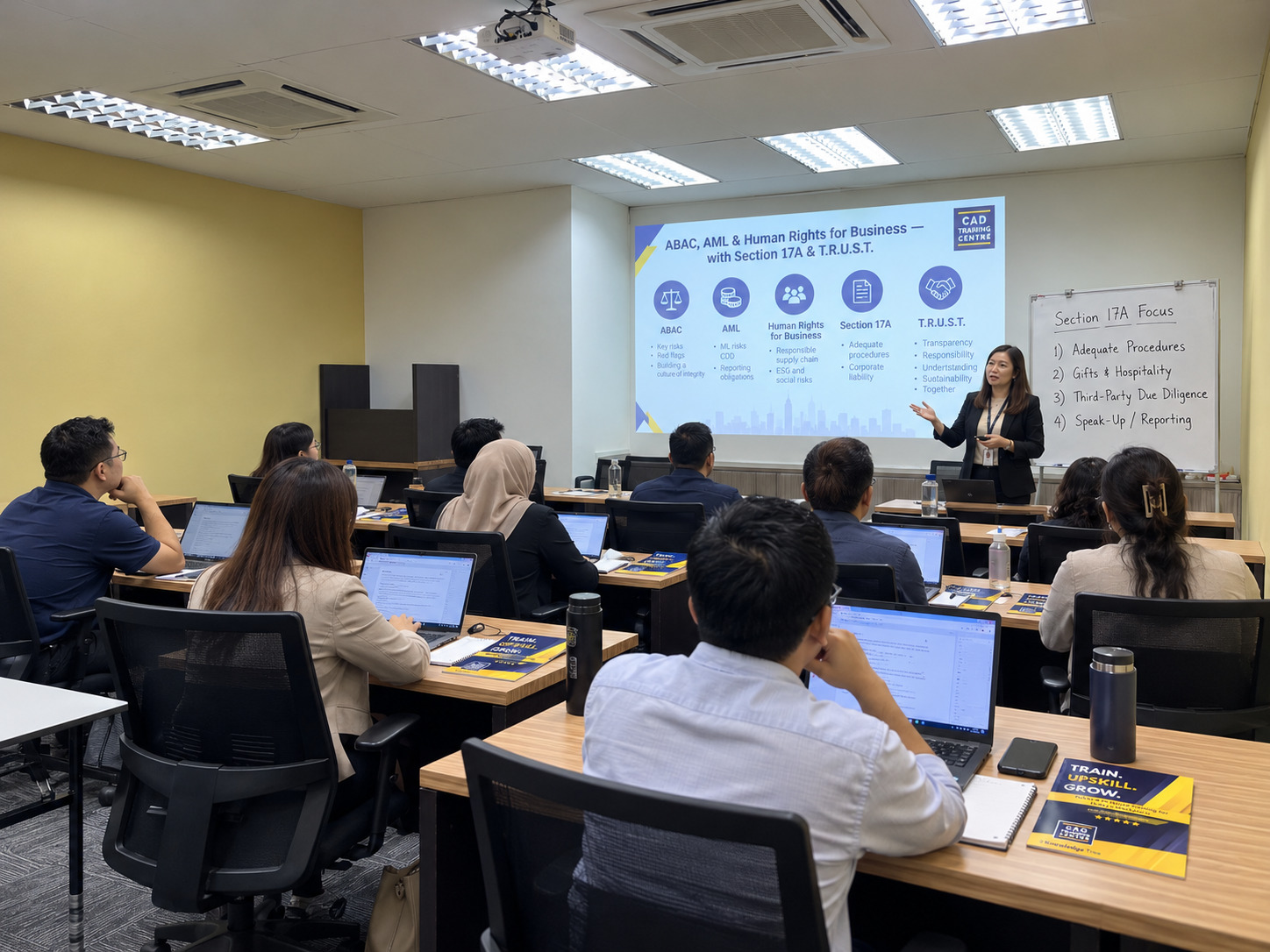
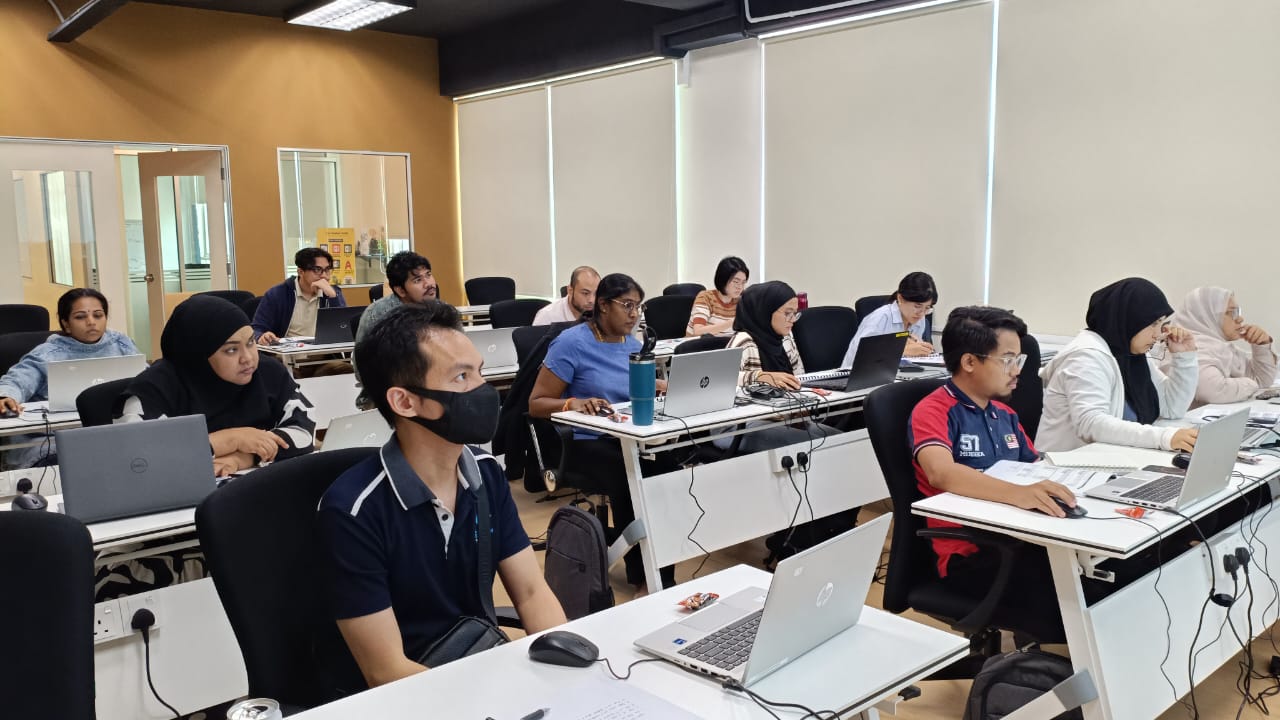
The Anti-Bribery, Anti-Corruption (ABAC), Anti-Money Laundering (AML) & Human Rights Training Course at CAD Training Centre is a comprehensive, HRD Corp claimable program designed for employees, managers, supervisors, and business leaders across Malaysia. Spanning critical compliance areas like the MACC Act Section 17A and the T.R.U.S.T. framework, this practical workshop translates complex legal requirements into actionable workplace strategies—covering red flag detection, preventive controls, and ethical risk management. Training is available physically in Puchong, Selangor—with laptops provided—or via live online sessions, complete with a certificate of completion and free repeat classes.

Not sure how Anti Bribery Anti Corruption, Anti Money Laundering, and Human Rights compliance actually apply to your daily work? Worried about bribery risks, suspicious transactions, vendor issues, ESG expectations, or corporate liability under Section 17A?

This Anti Bribery Anti Corruption, Anti Money Laundering & Human Rights Training is designed to help employees, managers, and business teams understand how compliance failures happen — and more importantly, how to prevent them. The course translates complex legal and regulatory requirements into practical workplace actions, helping participants identify red flags, make ethical decisions, strengthen internal controls, and protect the organisation from bribery, corruption, money laundering, and human rights risks. Companies often search for these courses by searching for ABAC course, ABAC training, AML course or AML training.

Whether you are joining the 1-Day Essentials Programme or the 2-Day Advanced Prevention, Detection & Response Programme, this training equips participants with practical tools to build a stronger culture of integrity, accountability, and responsible business conduct aligned with ABAC, AML, ESG, Human Rights, Section 17A, and T.R.U.S.T. principles.

Related Articles on AutoCAD 3D, Solid Modelling and Technical Design

https://www.autodesk.com/learn/ondemand/curated/autocad-quick-start-guide

https://help.autodesk.com/cloudhelp/2026/ENU/AutoCAD-Core/files/GUID-B554A4C0-006C-4EA5-BEB0-D501B79A79EE.htm

https://help.autodesk.com/cloudhelp/2026/ENU/AutoCAD-Core/files/GUID-3CE31F02-64A5-4BB8-9461-4C4F659C63B7.htm

https://help.autodesk.com/cloudhelp/2026/ENU/AutoCAD-Core/files/GUID-6C13448A-A109-4141-BA38-A7296967B4E5.htm

https://help.autodesk.com/cloudhelp/2026/ENU/AutoCAD-Core/files/GUID-FABC5079-9078-468A-8AAD-E61FEAD73815.html

Learning Outcomes

  • Understand how Anti-Bribery and Anti-Corruption (ABAC), Anti-Money Laundering (AML) and Human Rights risks arise in daily business operations.
  • Apply the Malaysian T.R.U.S.T. framework and understand its relationship with Section 17A of the MACC Act 2009.
  • Identify bribery, corruption and money laundering red flags across departments, business transactions and third-party relationships.
  • Develop preventive internal controls, approval procedures and third-party due diligence measures to reduce compliance risks.
  • Evaluate suspicious activities and determine appropriate escalation actions
  • Evaluate suspicious transactions and activities to determine appropriate internal reporting and escalation actions.
  • Understand whistleblowing procedures, investigation basics, documentation and evidence preservation.
  • Develop corrective actions and apply root cause analysis to address compliance failures and improve internal controls.
  • Integrate ABAC, AML and Human Rights responsibilities into an organisational compliance framework using risk-based governance and the RACI model.
Who is it for

  • Compliance, Risk & Legal Teams
  • Finance, Procurement & Operations staff
  • HR & People Management
  • Internal Audit & Governance teams
  • Sales & Business Development
  • Senior Management responsible for governance and corporate liability

Course outline

Module 1

Governance, Ethics & ESG Linkage

  • Understanding how compliance failures can affect organisations through real business cases
  • Exploring the relationship between ABAC, AML and the Governance (G) component of ESG
  • Understanding how Human Rights relate to the Social (S) component of ESG and Diversity, Equity and Inclusion (DEI)
  • Introduction to MACC Act Section 17A and corporate liability
  • Understanding Anti-Money Laundering Act (AMLA) fundamentals
  • Introduction to the T.R.U.S.T. Principles and their application in daily business activities
  • Practical activity: "Approve or Reject?" ethical decision challenge
Module 2

ABAC Risks in Daily Operations

  • Understanding what constitutes bribery beyond direct cash payments
  • Identifying bribery risks involving gifts and hospitality
  • Understanding risks associated with sponsorships and facilitation payments
  • Recognising high-risk areas involving procurement, vendor onboarding and contract approvals
  • Understanding Top Level Commitment (T) and the importance of leadership behaviour
  • Applying Risk Assessment (R) to identify bribery exposure points
  • Practical activity: Red Flag Mapping using a procurement scenario
Module 3

AML Awareness for Non-Bankers

  • Understanding the three stages of money laundering: placement, layering and integration
  • Recognising how businesses may unknowingly become involved in money laundering activities
  • Understanding the relationship between corruption and money laundering
  • Applying Risk Assessment (R) to identify suspicious transaction patterns
  • Practical activity: "Follow the Money" mini simulation
Module 4

Human Rights as Business Risk (ESG/DEI Lens)

  • Understanding human rights as an operational and ESG-related business risk
  • Identifying human rights exposure within workplaces and supply chains
  • Understanding reputational risks and investor expectations
  • Recognising forced labour and modern slavery risks
  • Identifying workplace discrimination, harassment and toxic work cultures
  • Understanding supplier exploitation, privacy and dignity concerns
  • Linking human rights responsibilities to ESG reporting
  • DEI practices and employer branding
  • Understanding Top Level Commitment (T) and Undertake Control
  • Measures (U) in promoting ethical conduct
  • Practical activity: "Profitable but Unethical – Continue or Stop?"
Module 5

Human Rights as Business Risk (ESG/DEI Lens)

  • Human rights as operational risk and ESG exposure, not CSR; key risks (forced labour, discrimination, harassment, supplier exploitation, privacy & dignity)
  • Activity: Case study — "Profitable but unethical — continue or stop?"
Module 6

Preventive Controls & Safeguards

  • Understanding the differences between a Code of Conduct, organisational ,policy and Standard Operating Procedure (SOP)
  • Applying segregation of duties as an internal control
  • Understanding approval thresholds and authorisation procedures
  • Maintaining audit trails for accountability and transparency
  • Conducting third-party due diligence
  • Applying Undertake Control Measures (U) under the T.R.U.S.T. framework
  • Practical activity: Designing preventive controls for individual departments
Module 7

Additional Activity: Integrity Pledge Commitment

  • Participating in a structured Integrity Pledge signing session
  • Formally committing to ethical business conduct and compliance standards
  • Acknowledging responsibilities relating to ABAC, AML and Human Rights
  • Reinforcing the organisation's Code of Conduct and T.R.U.S.T. Principles
Module 8

(Day 2)Detecting Red Flags & Suspicious Activities

  • Identifying suspicious patterns and anomalies in business transactions
  • Recognising red flags involving payments and invoices
  • Detecting potential compliance risks in vendor relationships and contracts
  • Identifying suspicious employee behaviour
  • Introduction to trade-based money laundering
  • Understanding the importance of verifying unusual activities
  • Applying Systematic Review
  • Monitoring & Enforcement (S) under the T.R.U.S.T. framework
  • Practical activity: Spot the Suspicious Pattern Challenge
Module 9

Whistleblowing & Internal Reporting

  • Understanding why employees may hesitate to report misconduct due to fear, workplace culture or retaliation, Developing safe and accessible internal reporting channels
  • Understanding the importance of protecting whistle-blowers
  • Establishing clear escalation procedures for reporting compliance concerns
  • Identifying roles and responsibilities when handling whistleblowing reports
  • Applying Systematic Review (S) and Training & Communication (T) principles
  • Practical activity: Role play on receiving a whistle-blower complaint
Module 10

Investigation Basics & Evidence Handling

  • Understanding the appropriate steps when an allegation of misconduct arises
  • Recognising actions to avoid during an internal investigation
  • Maintaining proper investigation documentation
  • Understanding interview procedures and evidence preservation
  • Identifying the responsibilities of HR, compliance teams and management during investigations
  • Applying Monitoring & Enforcement (S) principles
  • Practical activity: Mini Investigation Simulation
Module 11

Corrective Actions & Root Cause Analysis

  • Understanding how to address compliance failures by improving organisational systems
  • Applying root cause analysis to identify underlying compliance weaknesses
  • Understanding the differences between preventive, detective and corrective controls
  • Strengthening governance procedures after compliance failures
  • Applying Systematic Review & Improvement (S) principles
  • Practical activity: Fix the Broken System Workshop
Module 12

Integrated Compliance Framework (ABAC + AML + Human Rights)

  • Understanding the importance of integrating compliance responsibilities across departments
  • Applying a risk-based approach to organisational compliance
  • Introduction to the RACI model for governance and accountability
  • Integrating compliance requirements into human resources processes
  • Applying compliance principles within procurement, finance and operations
  • Reviewing and mapping the T.R.U.S.T. Principles across organisational functions
  • Final practical activity: Building Your Organisation's Compliance Blueprint
Module 13

Workshop Deliverables

  • Signed Integrity Pledge Certificate (Individual Copy)
  • ABAC & AML Red Flag Checklist
  • Human Rights Risk Checklist (ESG-aligned)
  • Third-Party Due Diligence Template
  • Internal Control & Approval Matrix
  • Whistleblowing SOP
  • Investigation & Escalation Flow

Course format

Choose the delivery mode that fits your team and timeline.

  • 01

    Classroom

    Instructor-led sessions in our Bandar Puteri labs with guided exercises, live demos, and peer discussion.

  • 02

    Online

    Live virtual delivery with the same syllabus, shared files, and instructor checkpoints — ideal for distributed teams.

  • 03

    In-house

    Private cohorts for your organisation, scheduled around project deadlines with content tailored to your standards.

Upcoming schedule

Public intakes coming up.

  • 30 Nov 2026 - 1 Dec 2026 9:00 AM – 5:00 PM · Face-to-face

Certification & policies

Certificate of attendance

Receive a certificate of attendance upon completing the programme, suitable for HR records and continuous learning portfolios.

Free Repeat Class

Free Repeat Class: if you need another pass at the same public syllabus within 6 months, you may re-attend subject to seat availability.

Materials provided

  • Course workbook / digital notes
  • Exercise files and sample templates
  • Certificate of attendance
  • Post-class support window for clarification questions

Frequently asked questions

01 What is the Advanced Prevention, Detection, and Response Strategies for ABAC, AML & Human Rights course about?

Our Advanced ABAC, AML & Human Rights Training Course helps professionals strengthen their organisation's ability to prevent, detect and respond to bribery, corruption, money laundering and human rights risks. The programme covers MACC Act Section 17A, the T.R.U.S.T. framework, internal controls, suspicious activity detection, whistleblowing, investigation procedures and corrective actions.

02 Do I need to attend the 1-day ABAC Essentials course before joining the 2-day Advanced course?

No separate attendance requirement is stated in the course outline. The 2-day Advanced programme includes the same five foundational modules covered in the 1-day ABAC, AML & Human Rights Essentials course, followed by an additional day of detection and response strategies. Participants can therefore develop foundational awareness before progressing to practical compliance management activities.

03 What is the difference between the 1-day ABAC Essentials course and the 2-day Advanced ABAC course?

The 1-day Essentials course focuses on understanding ABAC, AML and Human Rights responsibilities, identifying bribery and money laundering risks, applying preventive internal controls and understanding the T.R.U.S.T. framework. The 2-day Advanced course includes all five modules from the Essentials programme, plus an additional day covering suspicious activity detection, whistleblowing, investigation basics, evidence handling, root cause analysis, corrective actions and integrated compliance frameworks. Participants will also work on developing an organisational compliance blueprint.

04 What will I learn about whistleblowing and internal investigations?

You will learn how to establish safe reporting channels, understand whistle-blower protection considerations and develop clear procedures for escalating compliance concerns. The course also introduces investigation basics, including documentation, interviews, evidence preservation and the responsibilities of HR, compliance teams and management.

05 How long does the Advanced ABAC, AML & Human Rights course take?

The course is a 2-day training programme, with sessions running from 9:00 AM to 5:00 PM.

06 Do I need to bring my own laptop for the Advanced ABAC, AML & Human Rights training?

No. CAD Training Centre provides laptops for participants attending physical classes at our Puchong centre. You may bring your own laptop if preferred. Training activities include case studies, scenario-based discussions, role plays and practical compliance workshops.

07 Will I receive a certificate after completing the Advanced ABAC, AML & Human Rights course?

Yes. Participants receive a certificate upon completing the training.

08 What language is the Advanced ABAC, AML & Human Rights course conducted in?

The training is conducted bilingually in English and Bahasa Melayu.

09 Is the Advanced ABAC, AML & Human Rights training HRD Corp

Yes. Our Advanced Prevention, Detection, and Response Strategies for ABAC, AML & Human Rights Training Course is HRD Corp claimable, subject to the applicable eligibility and approval requirements.

10 Can I attend the Advanced ABAC, AML & Human Rights training online instead of in a classroom?

Classroom training means physical attendance in Puchong with face-to-face guidance and co-learning with other participants. Online training runs live via Zoom with interactive discussions, group challenges and guided exercises, making it suitable for participants outside the Klang Valley or those who prefer to save travelling time.

11 Can I repeat the Advanced ABAC, AML & Human Rights course if I need a refresher

Yes, free repeat classes are offered, no questions asked, if you need a refresher.

12 Is there a surau (prayer room) available at CAD Training Centre?

Yes, we have a surau available at our training centre in Puchong. Muslim participants can use the prayer room during breaks throughout the training day.

Next step

Register your interest

Share a few details and we will confirm seats, HRD Corp claimability, and the best public or in-house option for this course.

Training type